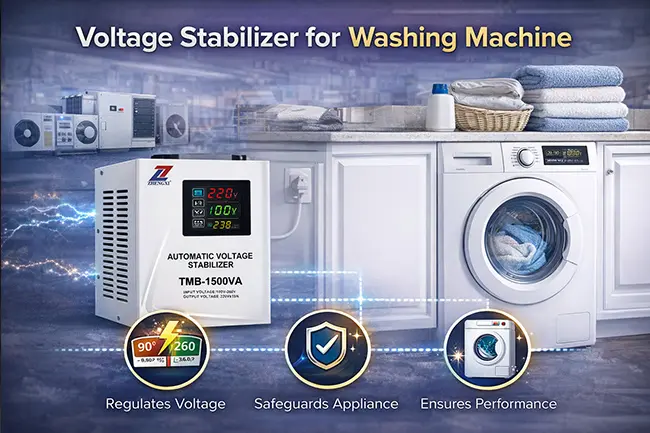
 Living in areas with frequent power outages, voltage drops, and unstable electricity supply makes your washing machine vulnerable to various problems.
Modern washing machines, especially fully automatic and inverter models, require stable voltage to operate efficiently. Even the smallest fluctuations in voltage levels can negatively affect their performance.
Whether you are a homeowner, distributor, or wholesale supplier, choosing the right home-type voltage stabilizer to protect washing machines from voltage fluctuations is essential. In this guide, we will explain how to select the most suitable stabilizer for your application.
What Is the Best Stabilizer for a Washing Machine?
The best washing machine stabilizer should have the following features:
• Voltage range: minimum 140V–260V (for unstable areas 90V–300V preferred)
• Capacity: 20–30% higher than the device load
• Protection functions: overload, voltage surge, short circuit, and thermal protection
• Type: automatic or digital stabilizer recommended
Why Do Washing Machines Need a Voltage Stabilizer?
Modern washing machines are equipped with the following sensitive components:
• Microcontrollers
• Inverter motors
• Sensors and control boards
These components are highly sensitive to voltage instability.
According to IEEE power quality standards (such as IEEE 1159), voltage fluctuations and sudden transients can significantly reduce the lifespan of electronic devices.
What Can Happen Without a Stabilizer?
• High voltage → damage to the PCB board
• Low voltage → motor overheating and poor performance
• Voltage surges → sudden shutdown or system failure
• Frequent fluctuations → long-term wear and reduced device lifespan
Benefits of a Washing Machine Stabilizer
An ideal voltage stabilizer does more than just prevent potential problems:
• Provides reliable and stable voltage
• Prevents costly repair expenses
• Improves energy efficiency
• Extends the lifespan of the appliance
• Reduces after-sales service issues (especially important for suppliers)
Types of Voltage Stabilizers for Washing Machines
1. Automatic Voltage Stabilizer
This is the most efficient and widely used option for household and small commercial applications.
Features:
• Automatic voltage regulation
• Wide input voltage range (140V–260V)
• Built-in safety systems
• Easy installation (Plug-and-Play)
Suitable for: homes, apartments, and retail users.
2. Digital Stabilizer
Uses microprocessor control for higher precision and faster correction.
Main features:
• Real-time voltage display (LED/LCD)
• More precise voltage correction
• Intelligent protection logic
Suitable for: premium household appliances and high-end market segments.
3. Energy-Efficient Stabilizer
Designed to reduce energy losses through optimized transformer and circuit design.
Main features:
• Lower power consumption
• Reduced heat generation
• Longer operational lifespan
It is becoming increasingly popular in markets focused on energy efficiency.
How to Choose the Best Stabilizer for a Washing Machine?
1. Voltage Range (Most Important Factor)
• Normal conditions → 140V–260V
• Unstable regions → 90V–300V
If low voltage is frequently observed in your area, choose a wide-range stabilizer.
2. Load Capacity
Typical requirements:
Semi-automatic washing machine → 500–1000 VA
Fully automatic washing machine → 1000–2000 VA
Advice: Always choose a model with 20–30% extra power reserve.
3. Important Protection Features
Make sure the stabilizer includes:
• Overload protection
• Voltage surge protection
• Short circuit protection
• Thermal shutdown protection
4. Build Quality
High-quality stabilizers typically use:
• 100% copper transformers (longer lifespan)
• High-quality relays or servo motors
• Flame-retardant housing materials
These features are especially important for importers and brand owners.
5. Response Time
Relay type: 20–100 milliseconds
Servo / digital type: less than 10 milliseconds
Faster response = better protection for sensitive electronics.
Difference Between Stabilizer and Built-in Protection System
Many modern washing machines claim to have built-in protection systems. But is it enough?
Built-in protection systems usually have limited voltage range, basic surge protection, and moderate reliability.
An external stabilizer provides a wider voltage range, advanced protection features, higher reliability, and a significantly positive impact on the device’s lifespan.
In most real-world usage scenarios, an external stabilizer offers more reliable and complete protection.
Conclusion
Washing machines are equipped with modern technologies and are therefore more sensitive to voltage fluctuations. A properly selected voltage stabilizer protects the appliance from the negative effects of high and low voltage, ensures stable operation, and extends its service life. Especially in areas with unstable power supply, using a stabilizer is considered an essential choice for both device safety and long-term savings.
