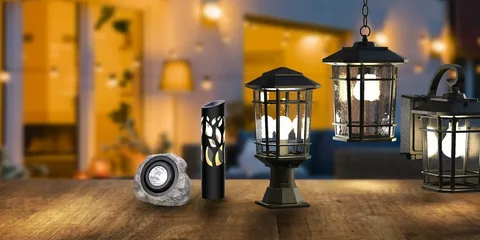
 Lighting the exterior of a building plays an important role in ensuring the aesthetic appearance and safety of residential houses, commercial, public, and other types of properties. With the help of different types of lighting fixtures, it is possible to emphasize the architectural style and design features of a building, highlight its advantages, hide imperfections, and make it stand out from other structures.
Requirements for Outdoor Lighting Fixtures
Outdoor lighting fixtures must have a number of features that allow them to be used in open-air environments.
• Strength and durability. Lamps must be resistant to mechanical damage, temperature changes, high humidity, and wind exposure. The optimal choice is lighting fixtures made from stainless steel, reinforced glass, and polycarbonate.
• Protection from dust and moisture. This factor depends on the installation location of the lamp. For areas such as gazebos, covered terraces, verandas, and balconies, an IP44 protection rating is sufficient. However, lamps used outdoors should have at least an IP65 protection rating.
• Energy efficiency. This is one of the most important requirements for modern lighting systems.
• Electrical safety. This is a key requirement for lighting fixtures that are not protected from weather conditions. For exterior building lighting, devices with reinforced insulation and protection classes II and III against electric shock are selected.
LED lighting fixtures meet all of these requirements most effectively and are gradually replacing other light sources.
LED Lighting: A Modern Solution in the World of Artificial Lighting
More and more businesses, organizations, and homeowners are replacing traditional incandescent bulbs with LED lighting devices. Outdoor lamps based on LED technology have many advantages and are therefore widely used.
Why Choose LED Lighting?
High Energy Efficiency
LED lamps consume 50–70% less electricity compared to other types of lamps. This significantly reduces utility costs. In addition, LED lamps do not overload electrical networks and ensure long-term system operation.
High Light Output
LED crystals and reflective housings work together to create a bright and intensive light flow. By using LED lamps, it is possible to achieve sufficient illumination with fewer light sources.
High Light Quality
Even when lighting fixtures are installed at a high height, the quality of light does not decrease. The light does not distort the space and does not cause eye discomfort. Voltage fluctuations also do not significantly affect light quality.
High Durability
Light sources are placed in strong, waterproof, and temperature-resistant housings. These housings protect LED elements from dust and moisture. After installation, these lamps require minimal additional maintenance.
Reliability
LED lamps are resistant to sudden voltage changes, short circuits, and impulse surges in the electrical network.
Long Service Life
The service life of LED light sources can reach 50,000–70,000 hours. This allows continuous exterior lighting of buildings for 5–12 years without replacing the lamps.
Types of Lamps for Exterior Building Lighting
Exterior lighting fixtures differ according to their purpose and installation method. They can be mounted on walls, attached with adjustable mechanisms, installed in the ground, or placed on columns and poles.
Floodlights
These are powerful lighting fixtures used for general and accent lighting of buildings. They are ideal for illuminating large areas and highlighting important architectural elements. Their design allows adjustment of the light angle and intensity.
Wall Lamps (Sconces)
Used to highlight specific elements of a building’s exterior. They are installed on walls and create directional lighting.
Linear Lamps
Used to create long light lines and decorative lighting effects. They are usually installed along cornices and other linear architectural elements.
Recessed Lighting Fixtures
Installed discreetly into walls, floors, pathways, and ceilings. They create soft, comfortable lighting and help achieve original lighting solutions.
LED Strips
An ideal choice for illuminating buildings with complex shapes. They are used to highlight building outlines, windows, doors, and architectural details.
Landscape Lamps
These include lanterns, ground lights, and column-style lighting fixtures. They are used to illuminate the area surrounding a building.
Functions of Exterior Lighting
Lighting fixtures provide a certain level of illumination, but they also perform different functions and create various visual effects.
Functional Lighting
Provides good visibility around a house at night and helps ensure the safe movement of people and vehicles.
Functional lighting is used for:
• built-in spotlights for stairs and pathways;
• motion sensor lamps (activated when a person, animal, or vehicle approaches);
• wall lamps and lanterns for illuminating entrance areas.
Architectural Decorative Lighting
The main purpose of this type of lighting is to make the exterior appearance of a building and its individual elements more attractive, highlight its advantages, and create an aesthetic look.
Types of Decorative Lighting:
Flood Lighting
One of the most effective methods for illuminating the entire exterior surface of a building. Powerful floodlights are installed on the ground at a certain distance from the building and direct light upward.
Accent Lighting
Highlights columns, cornices, decorative elements, and other architectural details. Linear and spotlights are used for this purpose.
Contour Lighting
Linear lamps and LED strips are installed under roofs, on stairs, balconies, and along the perimeter of a building. This emphasizes the precise and elegant lines of the structure.
Dynamic Lighting
Used during holidays and special events. RGB LED strips and control systems allow changing colors, brightness levels, and lighting effects.
In most cases, exterior building lighting is created by combining several types of lamps. This makes it possible to create a unique lighting composition and fully benefit from both functional and decorative lighting solutions.
Choosing Color Temperature and Light Color
When selecting exterior lighting, lamps are chosen not only according to their type but also according to color temperature. This factor has a significant impact on how a building is perceived and the atmosphere created.
• Warm light (2700–3000K) – creates a comfortable and pleasant atmosphere and gives softness to the building. It is mainly used for residential houses and historical buildings.
• Neutral light (3500–4000K) – a universal choice suitable for buildings of different styles. It does not distort colors and presents the building in a natural appearance.
• Cool light (5000K and above) – used for modern and high-tech style buildings. It emphasizes strict and precise architectural lines.
Colored lighting is also widely used, but it is important to maintain the right balance to preserve the harmony of the building’s overall appearance.
Conclusion
Exterior lighting of buildings is an interesting and effective way to decorate houses and structures. To achieve both functional and aesthetic benefits, lighting fixtures must be selected correctly. During the selection process, not only the type and function of the lamp should be considered, but also the color temperature and light color.
