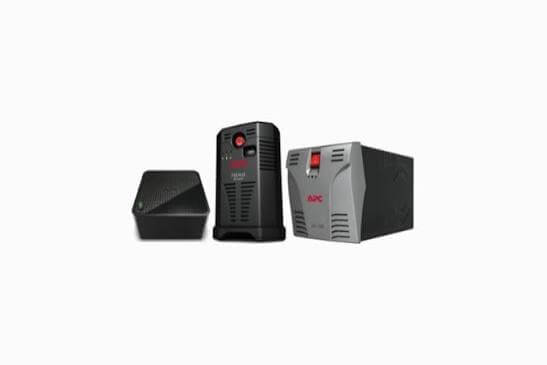
Why Are Your Electronic Devices Affected by Unstable Power?
A power stabilizer, also known as a voltage stabilizer or Automatic Voltage Regulator (AVR), is a device that automatically maintains a stable output voltage and protects equipment from voltage fluctuations.
When the incoming voltage is too low, the stabilizer increases it (boost). When the voltage is too high, it reduces it (buck). In this way, stable and safe voltage is supplied to connected devices.
Quick Guide to Power Stabilizers
What does it do? Corrects voltage drops, surges, and fluctuations to provide stable power.
Main types: Relay-type, servo-motor, and static/electronic stabilizers.
Key specifications: Capacity (VA/kVA), input voltage range, and output voltage accuracy.
Applications: Refrigerators, air conditioners, computers, medical equipment, and industrial machinery.
Not the same as a surge protector: A surge protector only protects against short-term high-voltage spikes; it does not regulate long-term voltage fluctuations.
Reliable power supply is not simply a matter of convenience—it is a necessity. Whether you are using electronic equipment in an industrial facility or at home, unstable voltage can cause serious damage to your devices.
Voltage fluctuations in the electrical grid occur more frequently than we may realize. Voltage can drop during periods of peak demand, rise when heavy loads are disconnected from the grid, or fluctuate because of aging electrical infrastructure. These situations do not always result in noticeable power outages. However, small and continuous voltage fluctuations can gradually damage sensitive electronic equipment.
Computers, medical devices, refrigerators, and industrial equipment are designed to operate within a specific and stable voltage range. When voltage falls below or rises above the normal level, components can overheat, electrical circuits can become overloaded, and the operating life of devices can be significantly reduced.
This is where power stabilizers play an important role. They act as a protective barrier between equipment and an unstable electrical grid, automatically regulating the incoming voltage and providing the stable power that devices require.
What Is a Power Stabilizer and How Does It Protect Your Devices?
A power stabilizer, also known as an Automatic Voltage Regulator (AVR), is an electrical device designed to provide a stable output voltage to a connected load regardless of fluctuations in the incoming or mains voltage.
Its primary purpose is to protect equipment from excessively high voltage, low voltage, and other voltage fluctuations.
The stabilizer continuously monitors the incoming voltage and makes the necessary adjustments in real time. Modern intelligent AC voltage stabilizers use microprocessor technology and power electronic components. These technologies allow them to provide high-quality, stable electrical power even when the mains voltage fluctuates significantly.
How Does a Stabilizer Work?
1. Sensing
The control circuit continuously measures the incoming AC voltage.
2. Comparing
The measured voltage is compared with the predefined required output voltage.
3. Regulation — Buck and Boost
If the input voltage is too low, the stabilizer activates boost mode. The system switches to a higher transformer output level, increasing the voltage.
For example, if equipment requires 220 V but the input voltage is only 195 V, the stabilizer can increase the voltage to approximately 220 V.
Conversely, if the input voltage is too high, the stabilizer switches to buck mode and reduces the voltage.
For example, if the input voltage rises to 260 V, the stabilizer can reduce it to a safe level for the connected equipment.
4. Protection
When the voltage reaches a critically low or high level, the stabilizer can completely disconnect the power supply. This function is essential for protecting connected devices from extreme voltage fluctuations.
How Does a Stabilizer Extend the Lifespan of Your Devices?
By providing stable voltage, a stabilizer reduces the electrical stress placed on electronic components.
Unstable voltage can force electronic devices to operate under increased stress, generate excess heat, and accelerate component wear. Stable voltage, on the other hand, helps prevent overheating, reduces the likelihood of component failure, and allows equipment to operate within its optimal operating range.
As a result, the service life and reliability of various devices—from refrigerators to sensitive laboratory equipment—can be improved.
How to Choose the Right Power Stabilizer for Your Needs?
Not all power stabilizers have the same characteristics. When choosing a stabilizer, you should consider the sensitivity of the equipment, the level of voltage fluctuations in your area, and your budget.
Relay-Type Stabilizers
Relay-type stabilizers are among the most common and generally more affordable types of voltage stabilizers.
They use relays to switch between different transformer output levels in order to regulate voltage.
Advantages:
Affordable price
Compact size
Suitable for household appliances
Easy to install and operate
Disadvantages:
Regulates voltage in steps
Voltage changes may occur during switching
Relays may produce a clicking sound
Slower response compared with other types
Output accuracy is generally around ±5–10%
Best suited for: Refrigerators, older air conditioners, televisions, and household appliances that can tolerate minor voltage fluctuations.
Servo-Motor Stabilizers
Servo-motor stabilizers use a servo motor to regulate voltage more precisely.
The servo motor moves across a variable transformer, providing smooth and continuous voltage regulation.
Advantages:
High output voltage accuracy, typically ±1%
Smooth and continuous regulation
Wide input voltage range
Ability to handle higher loads
Disadvantages:
Contains mechanical components
May have a slower response than static models
Requires periodic maintenance
May produce a low humming sound
More expensive than relay-type models
Best suited for: Industrial equipment, high-end household appliances, medical equipment, and other devices requiring precise voltage regulation.
Static Voltage Stabilizers (SVS)
Static stabilizers are among the most advanced solutions in voltage stabilization technology.
These devices have no moving parts and use power electronics such as IGBTs and PWM to regulate voltage.
Advantages:
Very fast voltage regulation
Response within milliseconds
High accuracy, typically ±1%
Silent operation
Minimal maintenance
No mechanical wear
Disadvantage:
Higher cost compared with other types of stabilizers
How to Calculate the Load?
Choosing the correct capacity is one of the most important steps when purchasing a power stabilizer.
1. Identify all devices
Make a list of all equipment that will be connected to the stabilizer.
2. Determine their power ratings
Check the label on each device or its user manual to find its power (W), current (A), and voltage (V).
3. Add the power ratings together
Calculate the total load by adding the power consumption of all connected devices.
4. Add a safety margin
It is recommended to add approximately 20–25% to the total power as a safety margin. This is particularly important for motor-driven appliances such as refrigerators and air conditioners, which can draw significantly higher current when starting.
Input Voltage Range
This specification determines the range of input voltage within which the stabilizer can provide a stable output.
If significant voltage fluctuations occur in the electrical network, it is generally more appropriate to choose a stabilizer with a wider input voltage range.
Output Voltage Accuracy
This specification indicates how accurately the stabilizer maintains the output voltage at the desired level.
For example, a stabilizer with ±1% accuracy can maintain a nominal 220 V output approximately within the range of 217.8–222.2 V.
High accuracy is particularly important for sensitive electronics and medical equipment.
Additional Protection Features in Stabilizers
Modern power stabilizers may include various additional protection and convenience features:
Time-delay system: Prevents appliances with compressors, such as refrigerators and air conditioners, from restarting immediately after a power interruption.
Overload protection: Automatically shuts down the system when the load exceeds the stabilizer's capacity.
High/low voltage protection: Disconnects the power supply when the input voltage reaches a dangerous level.
Digital display: Shows input and output voltage, load current, and other parameters in real time.
Wall-mounting option: Allows more efficient use of available space.
Smart features: Some modern models include RS232/RS485 communication interfaces for remote monitoring.
What Is the Difference Between a Power Stabilizer and a Surge Protector?
It is a common misconception that a power stabilizer and a surge protector perform the same function.
In reality, they protect against different types of electrical problems.
Power Stabilizer (Voltage Stabilizer/AVR)
A power stabilizer regulates long-term and continuous voltage fluctuations.
These include low voltage, high voltage, and unstable power supply. The stabilizer increases or decreases the voltage to provide a stable output.
Surge Protector
A surge protector protects against very short-term high-voltage spikes.
These spikes can be caused by lightning strikes, electrical grid switching, or the starting and stopping of powerful inductive loads.
When Should You Use a Stabilizer?
A power stabilizer is particularly useful:
During prolonged low-voltage conditions
During consistently high-voltage conditions
In areas with an unstable electrical grid
For protecting sensitive equipment
When Should You Use a Surge Protector?
A surge protector is useful:
To protect against voltage spikes caused by lightning
During electrical grid switching
To protect against short-term spikes caused by large electrical appliances switching on or off
Can They Be Used Together?
Yes.
In fact, for comprehensive protection, using both a voltage stabilizer and a surge protector is often recommended.
Some modern stabilizers already include built-in surge protection. This allows the equipment to be protected against both long-term voltage fluctuations and sudden voltage spikes.
Main Applications of Power Stabilizers
Residential Applications
Modern homes contain a large number of sensitive electronic devices. Even relatively small voltage fluctuations can affect their performance and operating lifespan.
Refrigerators and Air Conditioners
These appliances use compressors and are sensitive to voltage fluctuations. A stabilizer can protect the compressor against low and high voltage, potentially extending its service life.
Televisions and Home Theater Systems
Modern televisions, sound systems, and other electronic devices contain sensitive electronic circuits. Stable voltage helps them operate optimally.
Computers and Gaming Consoles
These devices are particularly sensitive to voltage fluctuations. Low voltage can cause system errors, data loss, and damage to power supply units. High voltage can seriously damage electronic components.
Commercial and Industrial Applications
In commercial and industrial environments, the consequences of electrical problems can be much more serious. Unstable power can lead to production downtime, financial losses, and equipment failure.
Offices
Protecting computers, servers, printers, and other office equipment against voltage fluctuations helps maintain business continuity.
Data Centers
Stable power supply is critical for servers, storage systems, and network equipment.
Medical Facilities
Hospitals and clinics use sensitive and expensive equipment such as CT scanners, X-ray machines, precision measurement devices, and diagnostic equipment. Even small voltage fluctuations can affect their operation and potentially damage expensive equipment.
Industrial Facilities
CNC machines and production lines: Automated systems operating with high precision require stable voltage.
Welding equipment and heavy machinery: Stable voltage can help improve equipment performance and extend its service life.
Oil fields, railways, and construction sites: In challenging environments with unstable power supplies, stabilizers can help protect control systems, communication equipment, and specialized tools.
Hotels and schools: Stable power is important for lighting, HVAC systems, kitchen equipment, and electronic educational tools.
Conclusion
The importance of a reliable power supply continues to grow in residential, commercial, and industrial environments.
A properly selected voltage stabilizer can help protect equipment against low and high voltage, improve operating efficiency, and extend service life.
When selecting a stabilizer, it is essential to consider capacity, input voltage range, output accuracy, protection features, equipment type, and intended application.
For particularly sensitive and expensive equipment, choosing the right voltage stabilizer is important not only for safety but also for long-term cost efficiency and reliable operation.
